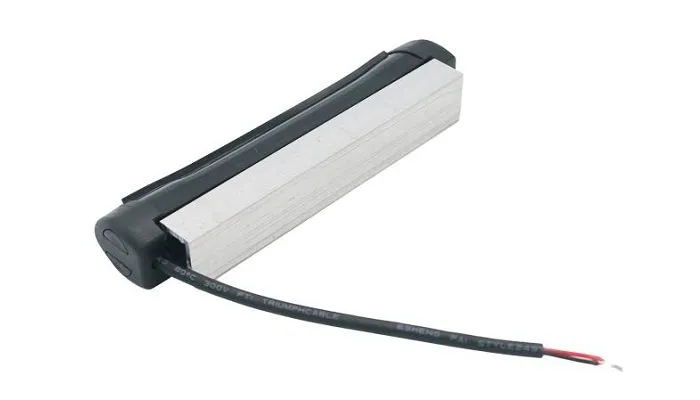
A safety edge is also known as a safety contact strip.
A safety edge is, in essence, a rubber strip-style switch containing an embedded conductive layer or pressure-sensitive structure. It typically consists of a flexible contact strip, along with an aluminum rail and a rubber sheath used for mounting and protection; its length can be cut to size or configured as a series of interconnected segments as required.
Its operating principle is based on pressure sensing, typically utilizing a normally open logic. When the safety edge is subjected to external pressure and undergoes deformation, its internal sensing elements instantly close (or open) the circuit, generating a switching signal that is transmitted to a controller (such as a safety relay or PLC), which then directs the equipment to execute a pre-programmed safety action.
The safety edge is a safety protection device designed for industrial equipment; it is widely utilized in machinery such as automated production lines, robotic systems, and lifting platforms. Through a highly sensitive sensing system, it detects contact with personnel or objects and responds immediately by halting the equipment's operation, thereby preventing injuries caused by improper operation or unforeseen circumstances.
The operating principle of a safety edge is based on pressure-sensing technology. During equipment operation, if the surface of the safety edge is touched or subjected to pressure, its built-in sensors instantly detect this change and transmit a corresponding signal to the control system.
This safety device finds extensive application in various fields, including automated equipment, robotics, packaging machinery, conveyor systems, and door and window mechanisms.