

Hey there! As a supplier of Roller Shutter Safety Edges, I often get asked about the durability of these nifty little devices. So, I thought I'd take a deep dive into this topic and share everything I've learned.

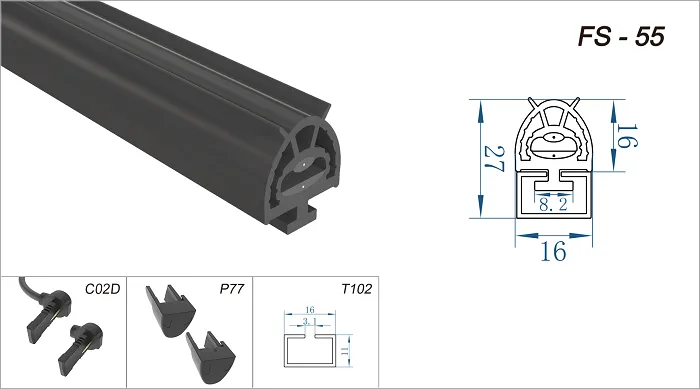
Let's start by understanding what a Roller Shutter Safety Edge is. It's a crucial component installed on the bottom of roller shutters. Its primary function is to detect any obstacles in the path of the closing shutter and immediately stop the shutter's movement to prevent any damage or injury. These safety edges are used in various applications, including Garage Door Safety Edge, Roller Shutter Safety Edge, Automatic Door Safety Edge, Car Door Safety Edge, and Safety Edge for Shutter Door.
What Affects the Durability of a Roller Shutter Safety Edge?
Material Quality
The material used to make the safety edge plays a huge role in its durability. Most safety edges are made from rubber or a combination of rubber and other polymers. High - quality rubber is resistant to wear, tear, and environmental factors like UV rays, moisture, and temperature changes. Cheaper materials may degrade quickly, leading to cracks, splits, or loss of flexibility. For example, a safety edge made from low - grade rubber may start showing signs of wear after just a few months of use, while a high - quality one can last for several years.
Installation Quality
How the safety edge is installed can also impact its longevity. A proper installation ensures that the safety edge is securely attached to the roller shutter and is aligned correctly. If it's not installed properly, it may not function as intended and could be more prone to damage. For instance, if the safety edge is not tightly fastened, it may get dislodged during the normal opening and closing of the shutter, leading to premature failure.
Usage Frequency
The more often a roller shutter is used, the more stress the safety edge will endure. In a commercial setting where the shutter is opened and closed multiple times a day, the safety edge will experience more wear compared to a residential garage door that is used only a few times a week. High - frequency usage can cause the rubber to fatigue and lose its elasticity over time.
Environmental Conditions
The environment in which the roller shutter operates can have a significant impact on the safety edge's durability. Extreme temperatures, whether hot or cold, can cause the rubber to expand or contract, leading to cracking or warping. Exposure to chemicals, such as cleaning agents or industrial pollutants, can also degrade the rubber material. Additionally, if the area is prone to high humidity or water exposure, the safety edge may be at risk of mold growth or corrosion of its internal components.
How to Measure the Durability of a Roller Shutter Safety Edge?
Lifespan
One of the most straightforward ways to measure durability is by looking at the expected lifespan of the safety edge. A well - made safety edge can last anywhere from 5 to 10 years, depending on the factors mentioned above. We often test our products in different simulated environments to estimate their lifespan accurately.
Resistance to Wear and Tear
This can be measured by conducting abrasion tests. We use specialized equipment to rub the safety edge against a rough surface and measure how much material is removed over a certain number of cycles. A durable safety edge will have minimal material loss, indicating that it can withstand regular use and contact with various surfaces.
Flexibility Retention
The ability of the safety edge to retain its flexibility over time is also an important indicator of durability. We perform bend tests to check how well the rubber can bend without cracking or losing its shape. If the safety edge can maintain its flexibility even after repeated bending, it's likely to last longer.
Tips to Increase the Durability of a Roller Shutter Safety Edge
Regular Maintenance
Simple maintenance tasks can go a long way in extending the life of the safety edge. This includes cleaning the safety edge regularly to remove dirt, debris, and any chemical residues. A soft brush and a mild cleaning solution can be used for this purpose. It's also important to check the alignment and attachment of the safety edge periodically and make any necessary adjustments.
Choose the Right Safety Edge for the Application
Not all safety edges are created equal. Make sure to select a safety edge that is designed for the specific type of roller shutter and the environment in which it will be used. For example, if the shutter is installed in an area with high UV exposure, choose a safety edge with UV - resistant properties.
Professional Installation
As mentioned earlier, proper installation is crucial. Always hire a professional installer who has experience working with roller shutter safety edges. They will ensure that the safety edge is installed correctly and that all the components are functioning properly.
Why Choose Our Roller Shutter Safety Edges?
At our company, we take durability seriously. We use only the highest - quality materials in the manufacturing of our safety edges. Our rubber is specifically formulated to be resistant to wear, tear, UV rays, and environmental factors. We also conduct rigorous testing on every batch of safety edges to ensure that they meet our strict quality standards.
Our safety edges are designed to be easy to install and maintain. We offer a wide range of products to suit different applications, whether it's a Garage Door Safety Edge for your home or an Automatic Door Safety Edge for a commercial building.
Contact Us for Your Safety Edge Needs
If you're in the market for a durable and reliable Roller Shutter Safety Edge, don't hesitate to reach out to us. We're here to answer all your questions and help you find the perfect safety edge for your requirements. Whether you're a contractor, a business owner, or a homeowner, we've got the solution for you.
References
- "Handbook of Rubber Technology", Morton M., Van Nostrand Reinhold, 1987.
- "Plastics in Building Applications", Ashby M.F., Jones D.R.H., Butterworth - Heinemann, 2005.